
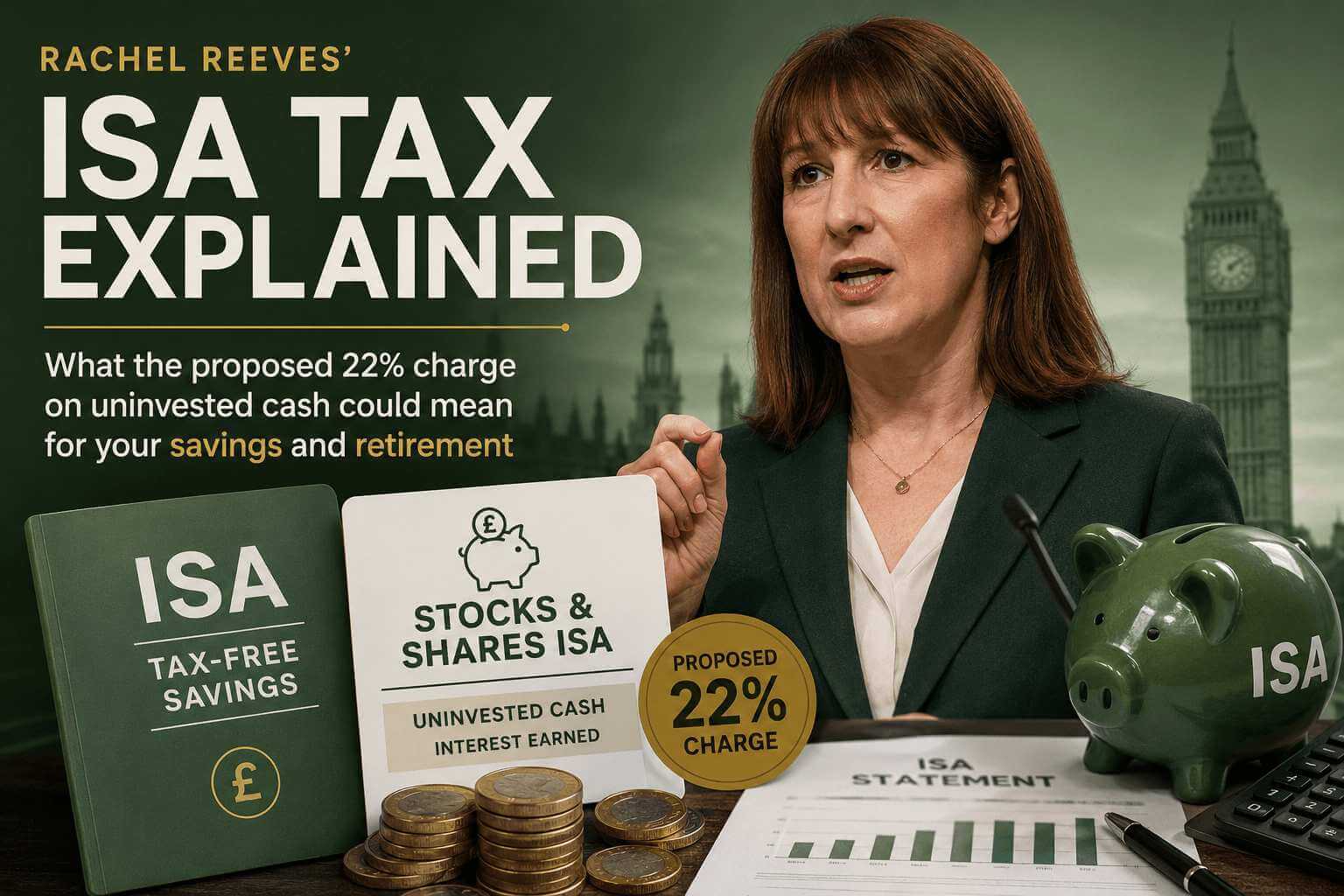
If you’ve spent any time on social media recently, you’ve probably seen alarming headlines claiming that Rachel Reeves is about to tax Stocks & Shares ISAs. For many investors, that’s enough to trigger immediate panic.
After all, ISAs have long been considered one of the best tax shelters available to UK savers. The ability to grow investments free from income tax, dividend tax and capital gains tax is one of the biggest advantages available to ordinary investors.
So when people hear the words “ISA tax,” it’s understandable that alarm bells start ringing. But before you rush off to rearrange your finances, it’s worth understanding what’s actually being proposed.
The truth is that the government is not proposing a tax on your shares, your investment funds, your ETFs, your dividends, or the gains you make from investing. Instead, the proposal targets something far more specific: the interest earned on cash that is sitting idle inside a Stocks & Shares ISA.
That distinction matters enormously.
While the proposal has sparked significant criticism from investors, pension experts and wealth managers, understanding why it exists—and what it could mean for your finances—requires looking at the bigger picture.
How We Got Here
To understand the proposed tax, you first need to understand what Rachel Reeves has been trying to achieve with her wider ISA reforms. For years, successive governments have worried that British households save too much in cash and invest too little.
From the Treasury’s perspective, this creates two problems.
First, cash savings generally produce lower long-term returns than investing in shares. Historically, stock markets have significantly outperformed cash over long periods, even after accounting for market crashes and recessions.
Second, cash sitting in savings accounts does very little to support business growth, innovation or economic expansion. Governments prefer money to be invested in companies, infrastructure and productive assets that can help grow the economy.
Rachel Reeves has repeatedly spoken about creating a stronger culture of investing in Britain rather than relying solely on cash savings.
That ambition sits behind a broader package of ISA reforms announced in recent budgets.
The Cash ISA Shake-Up
The biggest confirmed change is the reduction of the annual Cash ISA allowance. Currently, savers can place up to £20,000 per year into ISAs.
From April 2027, under the government’s reforms, individuals under the age of 65 will only be able to place £12,000 into a Cash ISA each year, while the overall ISA allowance remains £20,000. Savers over 65 will retain the full £20,000 Cash ISA allowance.
The government’s intention is fairly obvious.
By reducing the amount people can shelter in cash, ministers hope more savers will choose Stocks & Shares ISAs and invest in businesses rather than leaving money in savings accounts. But almost immediately, officials realised there was a problem.
The Loophole the Treasury Is Trying to Close
Imagine you’re a cautious saver. The government cuts your Cash ISA allowance to £12,000. You still want to keep your money in cash. What’s stopping you from opening a Stocks & Shares ISA, depositing the remaining £8,000 there, and simply leaving it uninvested while collecting tax-free interest?
In practice, not much.
Many investment platforms already pay interest on uninvested cash balances sitting inside Stocks & Shares ISAs. From the Treasury’s perspective, that would completely undermine the purpose of reducing the Cash ISA allowance in the first place.
The government’s answer is the proposed 22% levy.
What Exactly Is the Proposed 22% Tax?
Under reports that emerged earlier this year (2026), the Treasury has been considering a 22% tax charge on interest earned from uninvested cash held inside Stocks & Shares ISAs. The proposal is expected to coincide with broader ISA reforms due to take effect from April 2027.
In simple terms, the government is saying:
“If you want to use a Stocks & Shares ISA, we want you to invest. We don’t want you using it as a substitute cash savings account.” The proposal specifically targets interest generated by cash balances sitting inside the account.
That’s important because many people have misunderstood the headlines.
What Is NOT Being Taxed?
This is where much of the online confusion begins.
Under the proposal:
- Your shares are not being taxed.
- Your investment funds are not being taxed.
- Your ETFs are not being taxed.
- Your capital gains remain tax-free.
- Your dividends remain tax-free.
The proposal only targets interest generated from cash balances that are sitting uninvested inside the account. If you own a global index fund, a FTSE 100 tracker, an S&P 500 ETF, or a portfolio of individual shares, the proposal does not directly affect the tax-free growth of those investments.
That’s a critical distinction that many social media posts fail to mention.
Why Critics Are So Angry
Although the government’s reasoning is straightforward, the proposal has been heavily criticised throughout the financial industry. The main criticism is that holding cash inside a Stocks & Shares ISA is often a perfectly normal part of investing.
Investors don’t keep cash balances because they’re trying to exploit loopholes. Often they’re waiting for an investment opportunity. Sometimes they’re receiving dividends. Sometimes they’re preparing to rebalance their portfolio.
Sometimes they’re building cash to pay platform fees. In other words, cash is not necessarily sitting there doing nothing. It is often part of the investment process itself.
Critics argue that the government is treating every cash balance as evidence of someone trying to avoid the new Cash ISA rules. Many wealth managers also warn that the proposal creates unnecessary complexity in a system that was originally designed to be simple and accessible.
The Practical Problems Nobody Has Fully Solved Yet
One reason the proposal remains controversial is because implementation is surprisingly complicated. Consider a normal investor, you sell an investment on Monday. The cash sits in your account for two weeks while you decide what to buy next.
Does that cash become taxable immediately? After 30 days? After 90 days? Nobody seems entirely certain. Industry groups have repeatedly highlighted the difficulty of determining when temporary cash becomes “idle cash.”
This uncertainty is one reason many providers have been pushing back against the proposal.
Could This Affect Retirement Investing?
Potentially, yes. But perhaps not in the way people assume. The proposal is unlikely to damage long-term investors who remain largely invested throughout their lives. If most of your Stocks & Shares ISA is invested in funds, shares or ETFs, the impact would likely be minimal.
However, it could affect:
- investors who deliberately hold large cash balances,
- people approaching retirement,
- those gradually moving money out of investments and into cash,
- and investors who use cash as a defensive position during volatile markets.
For these groups, the proposal may reduce some of the flexibility that Stocks & Shares ISAs currently provide.
Is This Good News or Bad News for Retirement Savers?
The answer depends on your perspective. If you agree with the government’s view that too many people hold excessive amounts in cash, then encouraging greater investment could potentially improve long-term returns.
Historically, equities have significantly outperformed cash over multi-decade periods. Someone saving for retirement over 30 years will often build considerably more wealth through investing than through cash savings alone.
But critics argue that retirement planning is not one-size-fits-all. Many people deliberately hold cash for sensible reasons. Retirees often need stability. Some investors prefer lower risk. Others simply want flexibility. For these individuals, the proposal can feel less like encouragement and more like punishment.
That is why the debate has become so heated.
What Should You Do Right Now?
The most important thing is not to panic. At the time of writing, much of the discussion remains tied to proposals and implementation details that continue to evolve. If you are already invested inside a Stocks & Shares ISA, there is no indication that your shares, funds, dividends or capital gains are about to lose their tax-free status.
Those core ISA benefits remain incredibly valuable. Instead, use this as an opportunity to review how you’re using your ISA.
Ask yourself:
- How much of my Stocks & Shares ISA is actually invested?
- How much is sitting as cash?
- Why is it sitting there?
- Is that cash part of a deliberate strategy, or is it simply waiting to be invested?
For long-term retirement savers, remaining focused on investment strategy, diversification and costs is likely to have a far greater impact on future wealth than any tax on idle cash.
The Bigger Picture
What makes this proposal so interesting is that it reveals a much broader shift in government thinking. For years, ISAs were designed around a simple principle: encourage people to save. Increasingly, policymakers appear to be asking a different question:
Should tax incentives encourage saving—or investing?
Rachel Reeves’ proposed ISA reforms suggest the government is leaning heavily toward investing. Whether that ultimately benefits savers, the economy, or both remains one of the most fiercely debated questions in British personal finance today.
One thing is certain: this debate is far from over.