
Planning for retirement can feel overwhelming—especially when you start hearing terms like pensions, ISAs, annuities, and drawdown.
If you’ve ever asked yourself:
- What exactly is a pension?
- Do I really need one?
- How does it actually work in the UK?
You’re not alone. The good news is: pensions are much simpler than they seem, and understanding them could be one of the most important financial steps you ever take.
In this guide, we’ll break everything down in plain English, so you can clearly understand:
- What a pension is
- Pension-related deduction
- What is a pension scheme?
- How pensions work in the UK
- The different types available
- How much you might need
- How to get started today
Pension, What Is It?
A pension is a simple way of putting money aside during your working life so you can have an income when you stop working. Instead of relying only on your savings or the basic support from the government, a pension helps you build a dedicated pot of money for your future.
Over time, you regularly contribute to it, and in many cases, your employer and the government also add to it, helping your savings grow faster than if you were saving on your own. In simple terms: You save money during your working life so you can live comfortably when you stop working.
Think of a pension as a way of paying your future self. While you’re earning, you set aside a portion of your income, and when you retire, that money is there to support your lifestyle. It can help cover everyday expenses, give you more freedom, and provide peace of mind knowing you have a plan in place for later life.
Unlike a regular savings account, pensions are specifically designed to support you for 20–30 years after you stop working.
How To Find Out If I Have A Pension?
If you’re unsure whether you have a pension in the UK, start by checking with your current or previous employers, as many workers are automatically enrolled into workplace pension schemes. You can also review old payslips, P60s, pension statements, or employment contracts for details of pension contributions.
If you have moved house, make sure your former pension providers have your current address so they can send important updates about your pension. If you still cannot locate your pension, you can use the UK government’s Pension Tracing Service, a free service that helps you find contact details for workplace and personal pension providers.
Once you’ve identified the provider, you can contact them to confirm whether you have a pension and request information about its value and your retirement options. Regularly keeping track of your pensions can help you better plan for retirement and avoid losing touch with valuable pension savings.
Pension Changes
The UK pension system has undergone several significant changes over the years to encourage greater retirement saving and ensure pensions remain sustainable. One of the biggest reforms was the introduction of automatic enrolment, which requires eligible employees to be automatically enrolled into a workplace pension. This has led to millions more people saving for retirement, with both employers and employees making minimum pension contributions.
The State Pension has also seen major changes. In April 2016, the government introduced the new State Pension, replacing the previous two-tier system for people reaching State Pension age on or after 6 April 2016.
In addition, the State Pension age has gradually increased and is scheduled to rise further in the future, reflecting improvements in life expectancy and the need to maintain the long-term affordability of the pension system.
More recently, the government has made changes to pension tax rules and announced reforms aimed at improving pension outcomes. These include the abolition of the Lifetime Allowance tax charge, adjustments to annual pension allowances, and initiatives to encourage pension funds to invest more in productive UK assets. As pension rules continue to evolve, it is important for individuals to stay informed and regularly review their retirement plans to make the most of the benefits available.

Why Pensions Matter More Than Ever
These days, pensions matter more than ever because life has changed quite a bit. People are living longer, which is great—but it also means your retirement could last 20, 30, or even more years. That’s a long time to fund without a regular paycheck coming in.
On top of that, the cost of living continues to rise, so having a solid plan in place is no longer just a good idea—it’s essential.
The State Pension alone is usually not enough for a comfortable retirement—it’s more of a basic safety net.
Pension Related Deduction
In the UK, pension-related deductions mainly refer to the contributions made into pension schemes before or after tax. Employees enrolled in a workplace pension usually have a percentage of their salary deducted and paid into their pension, with employers also making contributions.
Depending on the pension arrangement, contributions may receive tax relief automatically, reducing the amount of income tax paid. Individuals can also make contributions to personal pensions or Self-Invested Personal Pensions (SIPPs), which generally qualify for tax relief up to the annual allowance, subject to eligibility and HMRC rules.
Other pension-related deductions can include National Insurance contributions, which help build entitlement to the State Pension, although they are not direct pension contributions. In retirement, pension income itself may also be subject to Income Tax if it exceeds the personal allowance, while withdrawals from defined contribution pensions are typically 25% tax-free, with the remaining amount taxed at the individual’s marginal income tax rate. Understanding these deductions can help individuals make informed decisions about saving for retirement and managing their tax liabilities effectively.
What Is A Pension Scheme?
A pension scheme is a structured retirement savings arrangement that enables individuals to accumulate funds during their working lives to provide an income in retirement. In the UK, pension schemes are broadly categorised into workplace pensions, which are arranged by an employer, and personal pensions, which are set up independently by an individual.
Under the UK’s automatic enrolment legislation, eligible employees are enrolled into a workplace pension scheme, with contributions typically made by the employee, employer, and supported by government tax relief. These contributions are invested over time with the aim of growing the pension fund until retirement.
There are two main types of pension schemes in the UK:
- Defined contribution (DC) schemes
- and defined benefit (DB) schemes.
A defined contribution scheme also known as money purchase pension scheme builds an individual pension pot based on the amount contributed and the performance of the underlying investments, meaning the retirement income is not guaranteed.
In contrast, a defined benefit scheme promises a predetermined retirement income, usually calculated according to an employee’s salary and length of service with their employer.
Pension schemes play a vital role in supporting financial security in later life by supplementing the State Pension and helping individuals maintain their standard of living after retirement. Academic research also highlights that well-designed pension schemes contribute to long-term financial wellbeing while supporting broader economic stability through long-term investment.
How Pensions Work
Pensions in the UK are designed to make saving for your future as smooth and rewarding as possible. At their core, they work by allowing you to set aside money regularly while you’re working, which then builds up into a pot you can use when you retire. The process is quite straightforward, and the system is set up to give your savings a helpful boost along the way—so you’re not doing it all on your own.
What makes pensions especially appealing is that they’re built with a few clever advantages that help your money grow more effectively over time. Instead of simply saving and hoping for the best, your pension benefits from extra contributions and long-term growth, making it a powerful way to prepare for a comfortable and secure retirement.
1. You Contribute Money
Everything starts with you setting aside a portion of your income. This can be done through your workplace or a private pension, and it doesn’t have to be a huge amount to make a difference. The key is consistency—regular contributions, even small ones, can build up significantly over time. It’s a simple habit that lays the foundation for your future financial security.
You regularly put money into your pension:
- Monthly contributions
- Employer contributions (if applicable)
2. The Government Adds Tax Relief
One of the biggest advantages of a pension is the extra boost you get from the government. When you contribute, a portion of the tax you’ve paid is added back into your pension. In simple terms, it’s like getting a bonus on your savings. This means your pension pot grows faster than it would if you were saving the same amount elsewhere.
If you contribute:
- £80 → the government adds £20
- Total = £100 in your pension
This is essentially free money from the government
3. Your Money Is Invested
Rather than sitting idle, your pension money is usually invested in things like companies and funds, giving it the chance to grow over time. While there can be ups and downs along the way, the long-term aim is to increase the value of your savings. This growth, combined with your contributions and tax relief, can make a big difference to the amount you have available when you retire.
Your pension is usually invested in:
- Stocks
- Bonds
- Funds
Over time, this allows your money to grow significantly
The 3 Main Types of Pensions in the UK
1. State Pension
The State Pension is the foundation of retirement income in the UK. It’s provided by the government and is based on your National Insurance contributions throughout your working life. Simply put, the more years you’ve paid in (or received credits), the more you’re likely to get when you reach State Pension age.
Think of it as your starting point rather than the full solution. It’s there to help cover basic living costs, but for most people, it won’t be enough to support the kind of lifestyle they’d like in retirement. That’s why it works best when combined with other types of pensions to give you more comfort and flexibility later on.
Key Features:
- Based on National Insurance contributions
- Paid from State Pension age (currently around 66–68)
- Provides a basic weekly income
Current full amount (approx):
Around £200+ per week (subject to change)
2. Workplace Pension
This is one of the most common and valuable types. A workplace pension is one of the easiest and most effective ways to save for retirement, especially if you’re employed. Your employer sets it up, and a portion of your salary is automatically paid into your pension each month.
The best part? Your employer also contributes, which means your savings grow faster without you having to do anything extra.
It’s a bit like teamwork for your future—you put in some money, your employer adds more, and together it builds into something meaningful over time. Because it’s automatic, it takes the pressure off remembering to save, making it a simple and reliable way to stay on track with your retirement goals.
How It Works:
- You contribute a percentage of your salary
- Your employer contributes too
- You receive tax relief
This is often the best and easiest way to start saving
3. Private Pension
A private pension is one you set up yourself, giving you more control over how much you save and how your money is managed. It’s a great option if you’re self-employed or if you want to top up your existing pensions. You decide how much to contribute and can often adjust this as your circumstances change.
Think of it as your personal top-up plan. It gives you the flexibility to boost your retirement savings and tailor things to suit your goals. Whether you want to retire earlier, travel more, or simply feel more secure, a private pension can help you build that extra layer of financial confidence for the future.
Ideal For:
- Self-employed individuals
- Those wanting to save more
You control:
- How much you contribute
- Where your money is invested
How Much Could Your Pension Be Worth?
- How much you save
- How early you start
- Investment performance
Example Scenario
If you:
- Save £200 per month
- Over 30 years
- With modest growth
You could build £100,000–£200,000+
Key Lesson
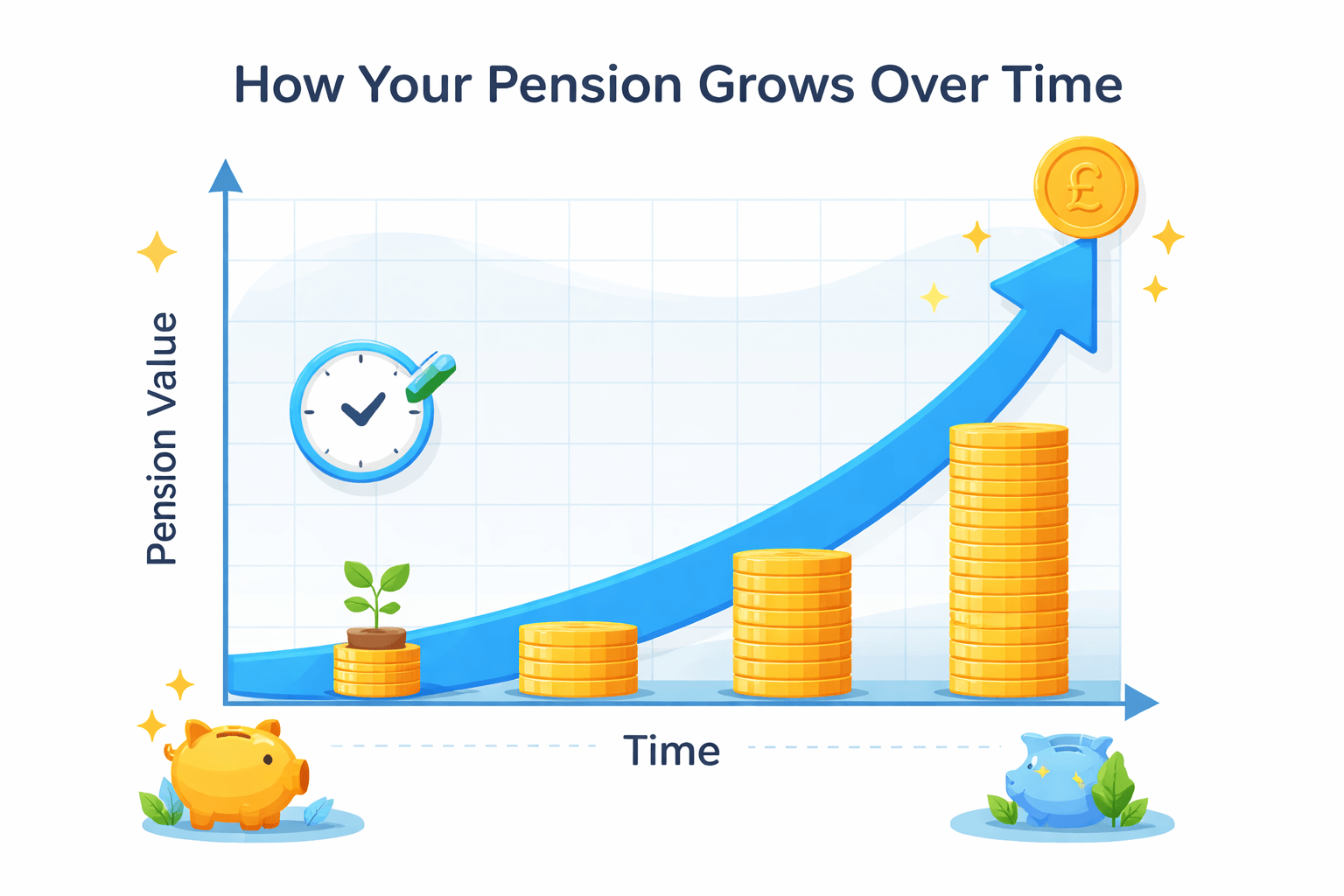
Time matters more than how much you invest
Starting early gives your money more time to grow.
How Do I Cash In My Pension?
In the UK, you can usually access your pension from the age of 55, depending on your pension scheme and circumstances, although this is set to rise to 57 (from 6 April 2028 for most people). This is known as the “minimum pension age,” and it’s the point where your pension savings become available to you. It doesn’t mean you have to stop working at that age—it simply means you have the option to start using your pension if you choose to.
If you have a defined contribution pension, you may be able to take up to 25% of your pension pot tax-free, with the remaining amount subject to Income Tax when withdrawn.
When you reach this stage, you have a few flexible options. You can take a portion of your pension as a lump sum, often with part of it being tax-free, or you can choose to take smaller amounts over time to create a steady income. Some people prefer to leave their pension untouched for longer, allowing it to keep growing while they continue working or use other savings first.
Before cashing in your pension, it is important to understand the tax implications and how withdrawing money could affect your long-term retirement income or entitlement to certain benefits. You should also check the rules of your pension provider, as options can vary between schemes. If you’re unsure which option is best for your circumstances, consider seeking guidance from Pension Wise or regulated financial advice before making a decision.
Also remember that your pension is designed to support you later in life, so it’s worth thinking carefully about when and how you use it. Taking money too early might mean having less later on, while waiting a bit longer could give your savings more time to grow. Finding the right balance depends on your goals, your lifestyle, and what feels right for your future.
Buying An Annuity
Buying an annuity is another way to turn your pension savings into a steady income for retirement. In simple terms, you use your pension pot to buy a product from a provider, and in return, they pay you a regular income—often for the rest of your life. It’s a bit like setting up your own personal paycheck that keeps coming in even after you’ve stopped working.
One of the main appeals of an annuity is the certainty it provides. You’ll know exactly how much you’ll receive and how often, which can make budgeting much easier. There are different types to choose from too—some pay a fixed amount, while others can increase over time or continue paying a partner after you’re gone. This flexibility allows you to shape your income around your needs and priorities.
That said, it’s important to think carefully before buying an annuity, because once it’s set up, you usually can’t change your mind. You’re exchanging your pension pot for long-term security, so it’s about finding the right balance between peace of mind and flexibility. For many people, it’s a reassuring option that takes the guesswork out of managing money in retirement.
Your options at retirement:
- Take 25% tax-free lump sum
- Withdraw money gradually (drawdown)
- Buy an annuity (guaranteed income for life)
Common Pension Mistakes to Avoid
When it comes to pensions, a few simple missteps can make a big difference over time—but the good news is they’re easy to avoid once you know what to look out for. Many people either delay getting started or don’t pay much attention to their pension along the way, often because it feels complicated or far off in the future. But small actions today can have a big impact later on.
Think of your pension like a long journey—you don’t need to rush, but you do need to stay on track. Avoiding common mistakes can help you make the most of your savings and give you more confidence about your future. With a bit of awareness and a few good habits, you can keep things moving in the right direction.
Below are some common pension mistakes that people make;
Starting Too Late
One of the biggest mistakes is putting things off. It’s easy to think retirement is a long way away, but time plays a huge role in how your pension grows. The earlier you start, the more time your money has to build up. Even small contributions made early can grow into something meaningful, so getting started sooner rather than later really makes a difference.
Not Taking Employer Contributions
If you’re part of a workplace pension, your employer will usually contribute alongside you—and this is something you don’t want to miss. Not taking full advantage of this is like leaving extra money on the table. By contributing enough to get the maximum from your employer, you’re giving your pension a valuable boost without extra effort.
Leaving Your Pension Unchecked
Once your pension is set up, it’s easy to forget about it—but that can be a mistake. Checking in on your pension from time to time helps you stay aware of how it’s growing and whether you’re on track. It also gives you the chance to make small adjustments if needed, which can make a big difference over the years.
Relying Only on State Pension
The State Pension provides a helpful foundation, but on its own, it may not be enough to support the lifestyle you want in retirement. Relying only on it can leave you with limited options later on. Building your own pension savings alongside it gives you more flexibility, comfort, and control over your future.
Pension Fund Investment
A pension fund investment refers to the way money held in a pension fund is invested to help it grow over time before retirement. When you and, in many cases, your employer make contributions to a pension, the money is typically invested in assets such as shares, bonds, property, cash, and other investment funds.
The aim is to achieve long-term growth so that your pension pot is worth more when you retire. The value of these investments can rise or fall depending on market performance, so there is no guarantee of returns in a defined contribution pension.
Pension fund investments are usually managed by professional fund managers, although some pension types, such as a Self-Invested Personal Pension (SIPP), allow individuals to choose and manage their own investments.
Most pension providers offer a range of investment funds with different levels of risk to suit different retirement goals and time horizons. Regularly reviewing your investment choices can help ensure your pension remains aligned with your financial objectives and risk tolerance as you move closer to retirement.
What Is The Pension Contribution?
In trying to figure out how much pension should I pay for retirement, it doesn’t have to be complicated. A simple starting point many people use is saving around 12–15% of their income over time. That might sound like a lot at first, but remember—you don’t have to jump there overnight. The key is to start with what you can afford and gradually increase it as your income grows.
What really matters is your personal lifestyle goals. Think about the kind of retirement you’d like—do you want to travel, enjoy hobbies, or simply live comfortably without financial stress? Your answer will help guide how much you need to save. Some people may need more, others less, but having a clear picture of your future makes it much easier to plan.
The most important thing is consistency. Saving a smaller amount regularly is far more effective than trying to save large amounts occasionally. And if you can start earlier, even better—your money has more time to grow. But no matter where you are right now, taking that first step and staying consistent will put you on the right path toward a secure and comfortable retirement.
A common guideline is:
Save 12–15% of your income
But your needs depend on:
- Your lifestyle goals
- Retirement age
- Existing savings
Simple Rule of Thumb
- Start early → save less
- Start late → need to save more
Simple Steps to Get Started Today
Getting started with your pension doesn’t have to feel overwhelming. In fact, it’s often the small, simple steps that make the biggest difference over time. You don’t need to have everything figured out right away—what matters most is taking that first step and building from there. Once you begin, it becomes much easier to stay on track and make steady progress.
Think of it like building a strong foundation for your future. Each step you take adds a little more security and confidence, helping you move closer to a comfortable retirement. With a few practical actions and a bit of consistency, you can set yourself up in a way that feels manageable and rewarding.
Here are some steps you can take to get you started on your journey to a financially satisfying life after retirement;
Step 1: Join Your Workplace Pension
If your employer offers a workplace pension, this is the easiest and most effective place to start. In most cases, you’ll be enrolled automatically, but it’s still worth checking that you’re actively contributing. This type of pension is designed to make saving simple, as the money is taken directly from your salary before you even have to think about it.
The real benefit here is that your employer also contributes to your pension. That means your savings grow faster without you having to do extra work. It’s one of the simplest ways to boost your retirement fund, so making sure you’re part of your workplace scheme is a smart first move.
Step 2: Increase Contributions Gradually
Once you’re set up, the next step is to slowly increase how much you contribute. You don’t need to make big jumps—small increases over time can have a powerful effect. For example, when your salary goes up, you could choose to put a little more into your pension rather than spending it all.
This gradual approach makes it easier to stay consistent without putting pressure on your day-to-day finances. Over time, these small increases can build into a much larger pension pot, helping you feel more secure about your future without feeling like you’re sacrificing too much today.
Step 3: Track Your Pension
It’s easy to set up your pension and then forget about it, but checking in regularly can make a big difference. Taking a little time once or twice a year to review your pension helps you understand how it’s growing and whether you’re on track for your goals.
Tracking your pension also gives you the chance to make adjustments if needed. You might decide to increase your contributions, or simply feel reassured that things are moving in the right direction. Either way, staying aware keeps you in control and helps you make more confident decisions about your future.
Step 4: Consider a Private Pension
If you want to take things a step further, a private pension can be a great addition. This is something you set up yourself, giving you more flexibility over how much you save and how often you contribute. It’s especially useful if you’re self-employed or want to boost your existing pension savings.
A private pension acts like a top-up, giving you an extra layer of financial security. It allows you to tailor your savings to suit your goals, whether that’s retiring earlier, having more freedom, or simply feeling more comfortable later in life. Even small contributions can make a meaningful difference over time.
Can You Take Out Pension Money?
Yes, in the UK you can usually take money out of your pension, but there are rules about when and how you can access it. For most defined contribution pensions, the normal minimum pension access age is 55 (this will be increasing soon). Depending on your pension scheme, you may be able to take your entire pension as a lump sum, make flexible withdrawals through drawdown, or use your pension savings to buy an annuity that provides a regular income.
Taking money from your pension too early or withdrawing a large amount at once could result in a higher tax bill and reduce the income available for your retirement. Before making a withdrawal, it’s important to understand the tax implications and consider seeking guidance or regulated financial advice if you’re unsure which option is right for you.
Taxation On Pension
The tax you pay on your pension depends on the type of pension you have and how you choose to take your money. For most defined contribution pensions, you can usually withdraw up to 25% of your pension pot tax-free, while the remaining 75% is generally treated as taxable income.
Pension withdrawals are added to your other income for the tax year and taxed at your applicable Income Tax rate if they exceed your Personal Allowance. State Pension payments are also taxable, although tax is not deducted before they are paid.
Pension contributions can also provide valuable tax benefits. Contributions to most workplace and personal pensions qualify for tax relief, meaning the government effectively boosts your retirement savings, subject to HMRC rules and annual allowance limits.
Because pension withdrawals can affect your overall tax position, it is often worth planning when and how you access your pension to help manage your tax liability and make the most of your retirement income.
Can I Cash In A Pension Early?
In most cases, you cannot cash in your pension early in the UK. Accessing your pension before the due date is generally only allowed in limited circumstances, such as if you are suffering from a serious ill health condition that meets your pension scheme’s rules.
Be cautious of companies that claim they can help you access your pension early, as these arrangements are often illegal pension liberation schemes and can result in significant tax charges and financial losses. Once you reach the minimum pension access age, you have several options for accessing your pension.
You may be able to take up to 25% of your pension pot tax-free, with the remaining balance usually subject to Income Tax when withdrawn. Depending on your pension provider, you can take a lump sum, make flexible withdrawals, or use your pension to buy an annuity that provides a regular retirement income.
Before accessing your pension, it’s important to understand the tax implications and consider seeking guidance or regulated financial advice if you’re unsure which option is best for your circumstances.
Do Pensions Form Part Of An Estate?
Whether a pension forms part of your estate in the UK depends on the type of pension and how it is structured. In many cases, defined contribution pensions do not form part of your estate for inheritance tax purposes if the pension provider or scheme trustees have discretion over who receives the benefits after your death.
Instead, the pension is usually paid directly to your nominated beneficiaries, making it a valuable tool for estate planning. It is therefore important to keep your expression of wish or beneficiary nomination form up to date.
However, some pension-related benefits and certain older pension arrangements may be treated differently. For example, once pension funds have been withdrawn and are held in your bank account, they generally become part of your estate and may be subject to inheritance tax if your estate exceeds the relevant thresholds.
Because pension and inheritance tax rules can be complex, it is advisable to review your pension arrangements regularly and seek professional financial or legal advice if estate planning is an important consideration.
Final Thoughts
Understanding pensions doesn’t have to be complicated. At its heart, a pension is simply a way of setting money aside today so you can enjoy life comfortably tomorrow. Whether it’s through the State Pension, a workplace scheme, or a private plan, each option plays a role in helping you build a more secure future. The key is knowing how they work and using them together in a way that suits your goals.
The most important thing to remember is that getting started matters more than getting everything perfect. Small, steady steps—like joining a workplace pension, contributing regularly, and keeping an eye on your progress—can make a big difference over time. With the right approach, you’re not just saving money, you’re building peace of mind, freedom, and confidence for the years ahead.